

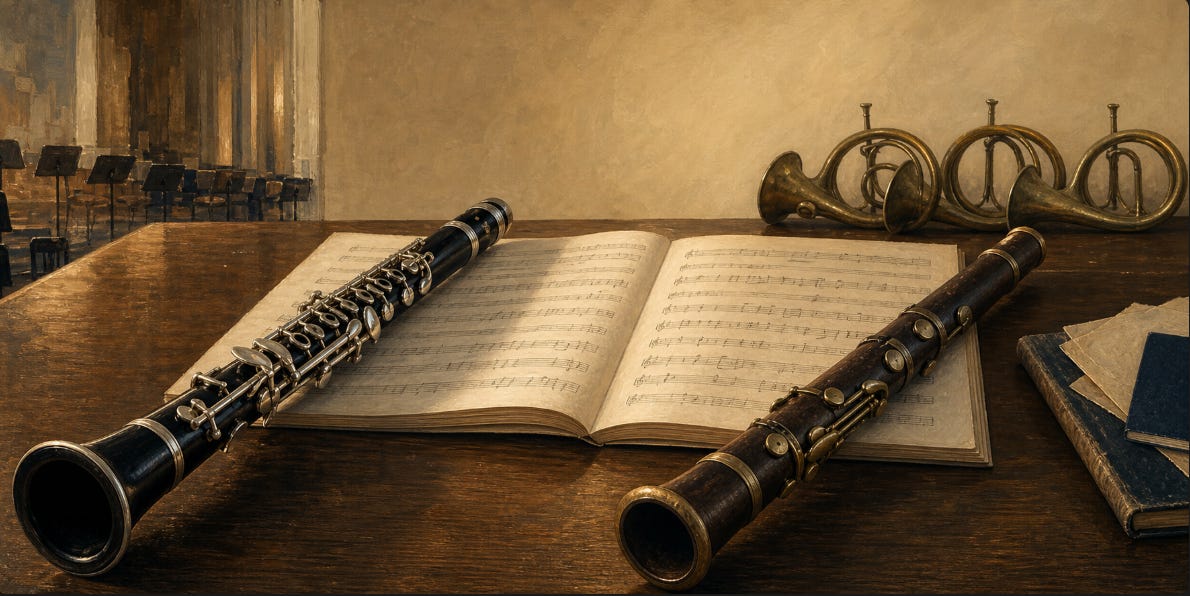
Carl Maria von Weber died two hundred years ago, on 5 June 1826, in London. He had gone there to put his opera Oberon on stage, and tuberculosis finished him off. That is the calendar reason for this post. The other reason is more personal. This year is also 215 years since his First Clarinet Concerto was first played, on 13 June 1811 in Munich. It is one of the concertos I once tried to play myself. In 1996, 30 years ago....
The work
Weber wrote the Concerto No. 1 in F minor, Op. 73 in about a month in 1811. He wrote it for Heinrich Baermann, the clarinet virtuoso of the Munich court orchestra. People say he wrote the whole first movement, orchestra and all, in a single day. Maybe that is not exactly true, but this is clearly an opera composer’s concerto. F minor is a dark, dramatic key. The clarinet sounds like a singer walking on stage: it broods in the first movement, and in the slow movement it holds a hushed conversation with three horns. That still surprises people who think early Romantic wind music is only pretty. The finale is a hunting rondo, fast and cheerful. Ten years later Weber wrote Der Freischütz. You can already hear the start of the theatre here.
I played it once, badly, a long time ago. I played the clarinet for fifteen years, roughly between 23 and 38, and this concerto sat right at the edge of what my fingers could do. Not good, in my own honest grade. That is part of why I keep coming back to it on record. I know exactly how hard the easy-sounding parts really are.
The recordings
Two readings, thirty years and one whole philosophy apart.
First, Walter Boeykens, with the Rotterdam Philharmonic under James Conlon (Harmonia Mundi, recorded January 1989, now on Warner). This is the modern-instrument one, and for me it is personal. I played a few times in a wind band in Bornem next to Boeykens and his daughter. Vlad Weverbergh, then his pupil, sat in the same section. (Weverbergh later became a period-clarinet specialist himself, which matters for the second recording.) Boeykens plays Weber the way a good teacher shows you a phrase: round, even, calm, nothing forced. The tone stays warm from bottom to top, and the slow movement is sung, not whispered. Warner’s own text calls him “a true legend of his art.” That is label talk, but in his case not far off. If you want this concerto to sound beautiful and safe, start here.
Second, Eric Hoeprich, with the Orchestra of the Eighteenth Century under Guy Van Waas (Glossa, 2020). Hoeprich plays a clarinet he built himself: a ten-key copy of a Griessling & Schlott from Berlin, the make Baermann actually bought in 1809, two years before the concerto. This is more or less what Weber heard in his head. The instrument is reedier and less even between the registers, and that unevenness is the whole point. The colours change from note to note instead of being smoothed out, and the natural horns behind it are more open and rougher than modern ones. Jarrett Hoffman, reviewing the disc for Early Music America (December 2020), called the sound “an ideal combination of mellow and clear” and praised the orchestra’s “energetic basses and bassoons.” He also had one honest complaint that fits this piece well: “Only in one work, Weber’s First Concerto, does that soloistic projection tend to be a little too intense.” Misha Donat, in BBC Music Magazine (January 2021, four stars), heard the good side. He pointed to the instrument’s “dark and husky chalumeau register” in the first movement’s development, and to “the warmth of its middle range” in the long passage for clarinet and three horns. His verdict: “there are precious few period-instrument recordings of these pieces, and this newcomer can confidently be recommended.”
So you can listen to them as if they were a small experiment. Same notes, two clarinets. Boeykens gives you the line; Hoeprich gives you the texture. In the slow movement, the passage where the clarinet answers the three horns is smoother and more blended on the modern instrument, and stranger and more vocal on the old one. In the finale, Boeykens is elegant where Hoeprich runs a bit wild, probably closer to what the Munich audience really heard in 1811.
Why still listen
Two hundred years later, this concerto is both a teaching piece and a war-horse. Usually that means it gets played well and heard without much attention. Putting these two recordings side by side helps with that. The modern one shows you how good the music can sound. The old one shows you what the composer was working with, and why some writing that looks only decorative was, at the time, almost impossible to play. I don’t think one is right and the other wrong. The distance between them is the main interest.
And there is a small private symmetry. Once I sat in a Bornem wind band, next to Boeykens. Now, many years later, I listen to younger players from his pupil’s school playing this same Weber on the old clarinet. Both versions of the instrument I half-learned now sit on the same shelf.
Sources & listen-along
Boeykens / Rotterdam Philharmonic / Conlon — Weber: Concertos & Concertino pour clarinette (Warner Classics / orig. Harmonia Mundi, rec. 1989). Warner Classics · Discogs
Hoeprich / Orchestra of the Eighteenth Century / Van Waas — Weber & Kurpiński: Clarinet Concertos (Glossa GCD 921128, 2020). Glossa · Chandos
Work, premiere (13 June 1811, Munich) and Baermann: Wikipedia — Clarinet Concerto No. 1 (Weber); Interlude
Reviews: Jarrett Hoffman, Early Music America (Dec 2020); Misha Donat, BBC Music Magazine (Jan 2021).
I am an amateur listener with a piano grade-2 background — these are just notes from an amateur, not authority.