

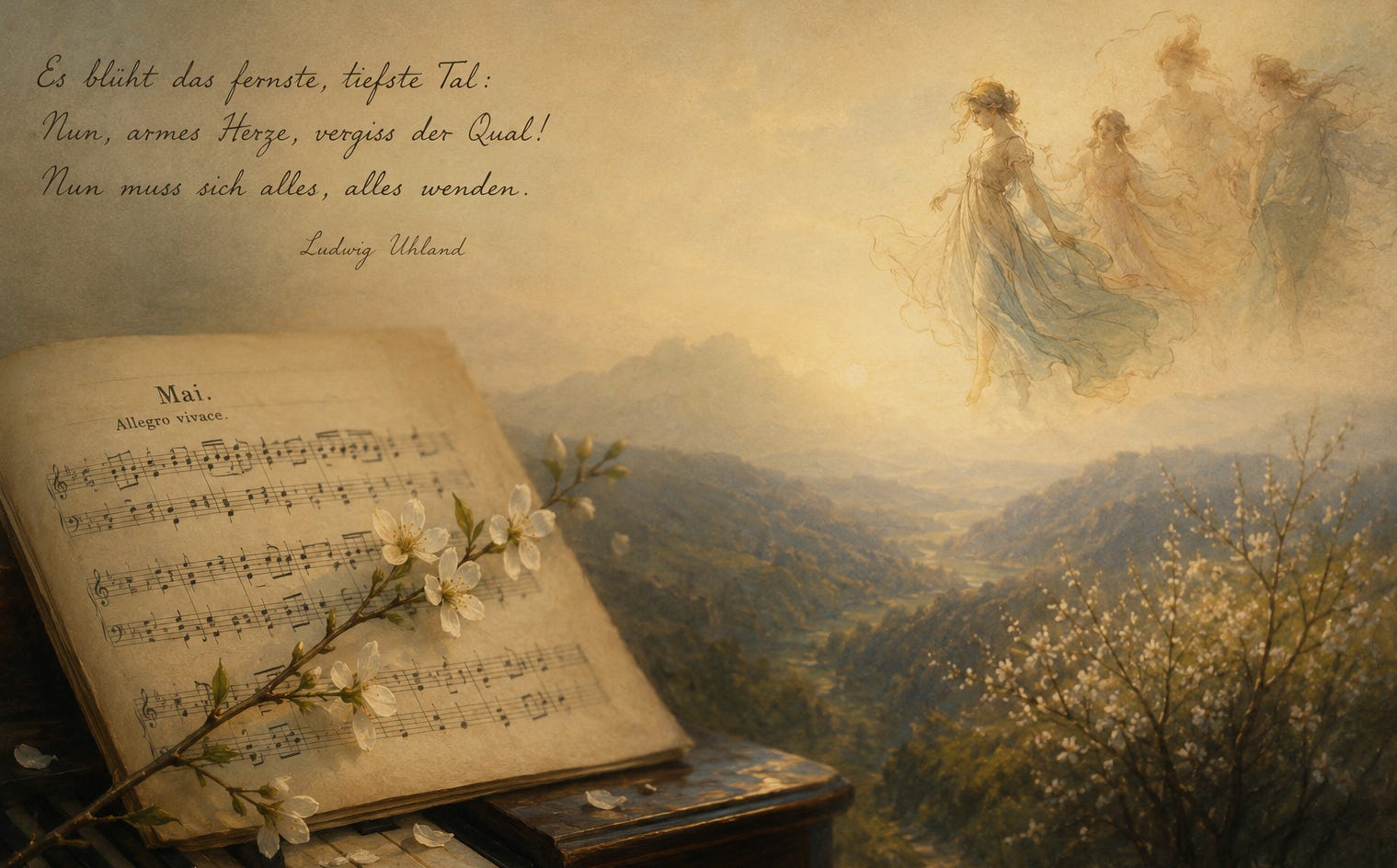
One hundred and seventy-nine years ago today, on 14 May 1847, Fanny Mendelssohn collapsed at the piano. She was rehearsing one of her brother Felix’s choral works for the next Sunday’s house concert. A stroke. She died that evening, forty-one years old. Felix outlived her by six months; most of his friends thought the grief killed him.
I am not a musicologist. I play piano at a level that keeps me honest about how hard it is, and I listen to a lot of music. Today felt like the day to write about her, and to write about one piece in particular: Mai, the fifth movement of her piano cycle Das Jahr (”The Year”), composed in Berlin between August and December 1841 (Bartsch, 2000).
A cycle of twelve months
Das Jahr is the work most musicologists now consider her magnum opus (Todd, 2010; Rodgers, 2010). Twelve character pieces for piano, one for each month, plus a closing Nachspiel: thirteen movements in all, around fifty minutes of music. Each month, in the “schöne Handschrift” reinschrift of 1843, carries two extra things on the page besides the score: a motto-poem chosen by Fanny, and a watercolour painted by her husband Wilhelm Hensel.
This matters. Wilhelm was a Prussian court painter, not a Sunday hobbyist. He had supported her composing from the day they married in 1829, and Das Jahr in its finished form is a piece of total art before the word existed: music, poetry, and image bound into a single object, a decade before Wagner started using Gesamtkunstwerk as a slogan.
Mai
The motto for Mai is Ludwig Uhland’s Frühlingsglaube, “Spring Faith”. Uhland was a Swabian poet from Tübingen, the same Romantic generation as Eichendorff. The poem is short, two stanzas, written in 1812. The text turns on a single image.
Die linden Lüfte sind erwacht,
Sie säuseln und weben Tag und Nacht,
Sie schaffen an allen Enden.
O frischer Duft, o neuer Klang!
Nun, armes Herze, sei nicht bang!
Nun muss sich alles, alles wenden.Die Welt wird schöner mit jedem Tag,
Man weiß nicht, was noch werden mag,
Das Blühen will nicht enden.
Es blüht das fernste, tiefste Tal:
Nun, armes Herze, vergiss der Qual!
Nun muss sich alles, alles wenden.
The line I keep returning to is the one in bold: Es blüht das fernste, tiefste Tal — “the farthest, deepest valley blooms”. Not the meadow. Not the garden. The remote one. The one nobody walks to. Even that valley blooms.
Uhland published Frühlingsglaube in his Gedichte (1815). The poem entered the German repertoire quickly: Schubert set it in 1820, Konradin Kreutzer’s setting circulated almost as widely, and Liszt later transcribed Schubert’s version for solo piano (S. 558/7). The poem’s pull comes from the asymmetry between the two stanzas. The first stanza notices that the world is waking up. The second stanza addresses the heart and orders it to wake up too. The hinge between the two is that one image, the farthest deepest valley, which works as a metaphor either way: the unreachable corner of the earth, or the unreachable corner of yourself.
Fanny’s setting is Allegro vivace, restless under a sunny surface. She does not paint May in postcard colours. The right hand chases a figure that keeps almost arriving and then sliding sideways; the left hand grounds it in steady motion. About two-thirds through, the music opens into a calmer middle section that hangs on a sustained upper voice. To my ear, that is where the deepest valley blooms. The piece resolves without showing off about it.
A Schubert hinge
Twenty-one years before Fanny, Franz Schubert had set the same Uhland text. Frühlingsglaube, D. 686, written in 1820, published as Op. 20 No. 2 (Reed, 1985). Schubert’s reading is slower, more grateful, more private. He gives the famous line a long held note in the voice over a falling piano line, and the harmony bends momentarily into something almost devotional.
Two of the great Lieder composers of the nineteenth century, working with the same poem within a generation of each other. The Schubert is a song for voice and piano; Fanny’s Mai is a piano piece that has the poem standing behind it, unsung. If you have half an hour, listen to them back to back: Lauma Skride on Sony or Gaia Sokoli on Piano Classics for Fanny’s Mai, Christa Ludwig on Deutsche Grammophon for the Schubert. They are doing the same job from two angles, a song that contains the words and a piece that has had the words pulled out and replaced with notes.
Gesamtkunst, in private
It is tempting to say Das Jahr anticipates Wagner. It does not. Wagner’s Gesamtkunstwerk is a public, theatrical, ideological project: opera as the rebuilding of culture. Das Jahr is a private artefact. It was written for the Mendelssohn family’s Sunday concerts and the autograph stayed in Wilhelm’s hands; the first complete publication waited until 1989 (Borchard, 1989; Furore-Verlag), 142 years after Fanny’s death.
But the principle is there, smaller and earlier and arguably purer: three art forms made by one couple, sitting on a single page. Sound, image, text. Wilhelm’s Mai watercolour in the autograph does not paint May the way you would expect. There is no meadow, no path, no obvious sunlight. The page shows half-formed figures suspended above the line: drifting, longing, slightly unfinished. It is closer to a dream than to a landscape, and that is exactly what Das Jahr is doing as a whole: not depicting the year, but describing how a year feels from the inside. The watercolour for Mai sets the mood the music then carries. Read the poem first. Look at the figures. Then play, or have someone play. The piece changes shape.
A small thing to do today
If you have a piano, the skill (I don’t) and a few minutes (probably rather weeks for me), play Mai. If you do not, the Skride recording (Sony, 2007) is the easiest first listen, and the Biesemans fortepiano recording (Pan Classics, 2018) is the most historically truthful. Whichever you choose, the line to keep in mind is Uhland’s, not Fanny’s, though by 1841 it had become hers as well.
Es blüht das fernste, tiefste Tal.
Even that valley blooms.
— John-Paul
Bronnen / References
Bartsch, C. (Ed.). (2000). Fanny Hensel: Das Jahr — Zwölf Charakterstücke (1841) für das Forte-Piano, kritische editie. Furore-Verlag.
Borchard, B. (Ed.). (1989). Fanny Hensel: Das Jahr. First complete publication. Furore-Verlag.
Reed, J. (1985). The Schubert Song Companion. Manchester University Press (entry on D. 686).
Rodgers, S. (2010). Fanny Hensel’s Das Jahr and the cyclic imagination. 19th-Century Music, 34(2), 191–217.
Todd, R. L. (2010). Fanny Hensel: The Other Mendelssohn, ch. 8. Oxford University Press.
Toews, J. E. (1993). Memory and gender in the remaking of Fanny Mendelssohn’s musical identity: The chorale in Das Jahr. The Musical Quarterly, 77(4), 727–748.
Uhland, L. (1815). Frühlingsglaube, in Gedichte. Cotta.