

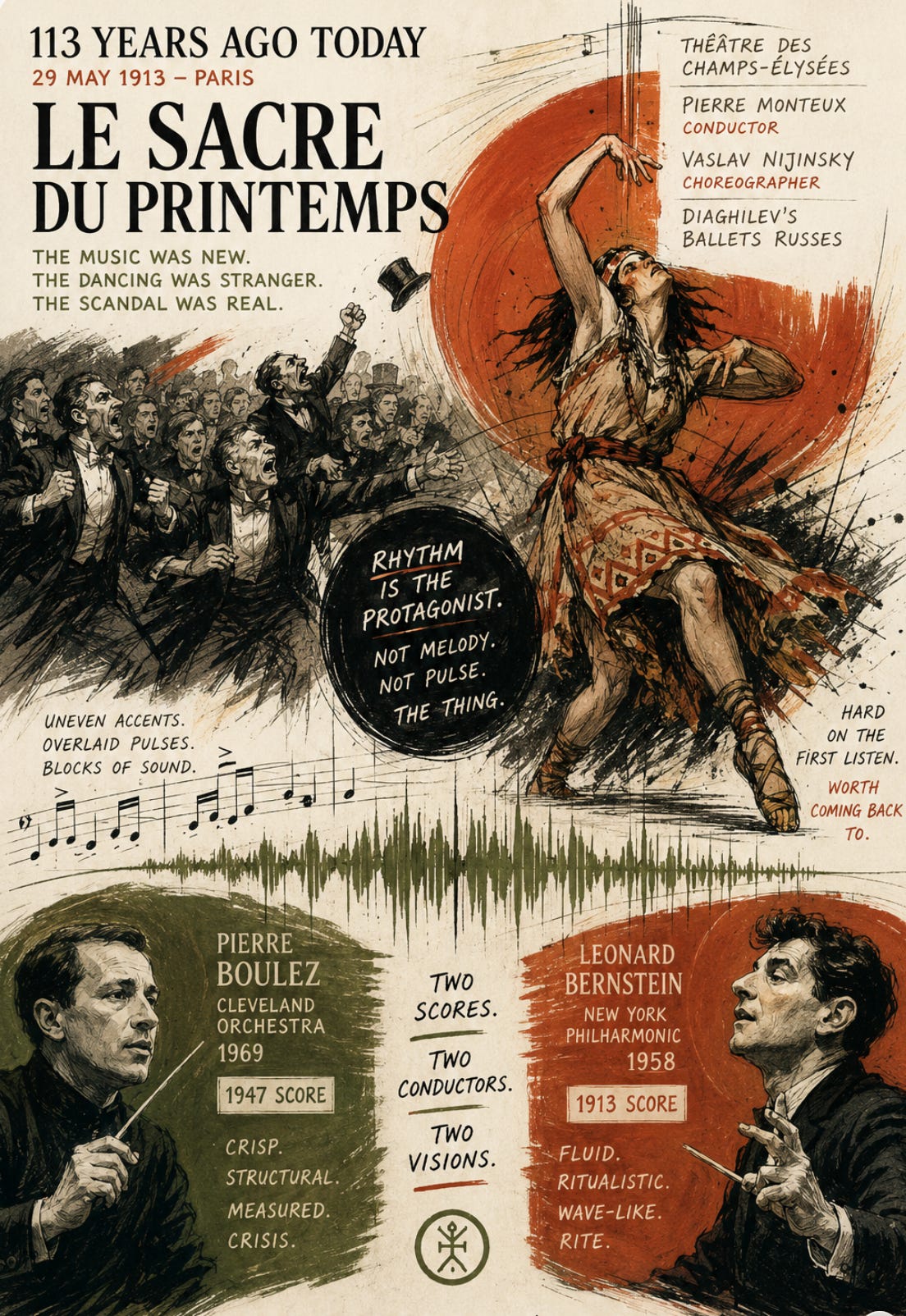
One hundred and thirteen years ago today, on 29 May 1913, the audience at the Théâtre des Champs-Élysées in Paris fought through the first performance of Le Sacre du printemps. Pierre Monteux conducted. Vaslav Nijinsky choreographed for Diaghilev’s Ballets Russes. People shouted, whistled, and reportedly came to blows. Music history files the evening as a scandal about the music. It was probably more of a scandal about the dancing. The notes were unfamiliar. The bodies on stage were even stranger.
I have known Le Sacre for forty years without ever sitting with it. For this first Long Listen, I tried, properly, with two recordings on two separate evenings.
The work
A ballet in two parts, about thirty-three minutes. Stravinsky imagined a pagan rite in pre-Christian Russia: tribes gather, a young woman is chosen, and she dances herself to death so the earth can be reborn. The score is built less on melody than on rhythm as a character in its own right: uneven accents, overlaid pulses, blocks of sound that change without a smooth handover. Two versions are in circulation. Stravinsky published the score in 1913 and revised it in 1947, mostly for copyright reasons, but with real differences in accents, dynamics, and orchestration. The two sound noticeably different in places.
The recordings
I compared two early-career studio takes.
Pierre Boulez, Cleveland Orchestra, 1969 (Columbia/Sony). The 1947 score.
Leonard Bernstein, New York Philharmonic, 1958 (Columbia/Sony). The 1913 score.
Both conductors would record Le Sacre again later in their careers. These were their first studio takes, and both were in their first peak. I listened on Qobuz through a closed-back headphone. Not my home reference rig because of traveling, but consistent across both recordings, which is what matters here.
First impression: Boulez is crisp, Bernstein is fluid. That stayed true across the four moments I tracked.
The opening
A high bassoon, then woodwinds dripping in. Stravinsky wrote the bassoon deliberately too high for comfort, so every instrument would feel caught. Boulez starts at rest. The bassoon is unhurried, and the oboe later is what holds my attention; Boulez gives it real room. The texture tips from pastoral into something else around [1:15]. Bernstein is slightly faster and more on edge. The same tip arrives two seconds earlier at [1:13], and the entries feel slightly cut off, more angular. Both are legitimate readings of the same score.
Augurs of Spring
The eight-note string chord with the hammered horn accents — the passage everyone remembers. Boulez plays the string accents as a push: weight forward, leaning. The horns are assertive. Bernstein plays the same accents as a chop, shorter, downward, with the horns kept under. The cellos sit at the bottom in both. Around [1:22] in Boulez and [1:23] in Bernstein, there is a switch, and the switches are not the same gesture. Some of that is interpretation; some may be the score versions, since the 1913 and 1947 accent patterns are not identical everywhere.
Glorification of the Chosen One
An asymmetric pulsing tutti, close to the end of Part Two. Boulez treats the meter as something to be measured. The bar changes are chopped, almost surgical, and the winds lead the texture. The feel is crisis. Bernstein is less strict. The meter changes wave through the orchestra, and the percussion comes more to the front. The feel is ritual, which is exactly the word the choreography intended. Two readings, two different things. Both correct.
Sacrificial Dance
The climax. Brutal meter changes, the standard test of a conductor’s nerve. Boulez is precise, a touch calmer than I expected, with sharper articulation; the percussion at the end dominates; the final chord is held, slightly open at the edges. After the last note, there are fourteen seconds of silence on the recording. Bernstein is more chaotic, but not carelessly. The openings of the meter changes are less surgical, the percussion stays more transparent inside the tutti, and the final chord lands as a single hit. Two seconds of silence after. The studios cut the tails differently, but the gestures are different too.
Why still listen
For most of the past hundred and thirteen years, almost all popular music has lived on a regular grid. Pop, rock, dance, most film scores — they keep time so dancers, editors, and listeners can hold on. Le Sacre is the first piece I know where rhythm itself is the protagonist, not a frame for melody, not a pulse to keep you oriented, but the thing the music is about. That is what makes it hard on the first listen, and it is what makes it useful to come back to. After two sessions, the asymmetry stops feeling like chaos and starts feeling like architecture.
I will be honest. I knew this piece for forty years without sitting still with it. It is an acquired taste, and I had not bothered to acquire it. Two evenings later, I am surprised by how much there is. If you have not listened in a while (or ever), today is a good day. Available on all streaming platforms and for free on YouTube. No excuses... But come back a few times, it is worth it!
Sources and listen-along
Boulez, Cleveland Orchestra, 1969 (Columbia/Sony) — on Qobuz, Spotify, Apple Classical, YouTube.
Bernstein, New York Philharmonic, 1958 (Columbia/Sony) — on Qobuz, Spotify, Apple Classical, YouTube.
Premiere date, conductor, and choreographer: Grove Music Online, lemma Rite of Spring, The.
The 1913 and 1947 score versions: Stravinsky, Le Sacre du printemps, entry on IMSLP.
I am an amateur listener with a piano grade-two background. These are listening notes, not authority and definitely no review.
— John-Paul