

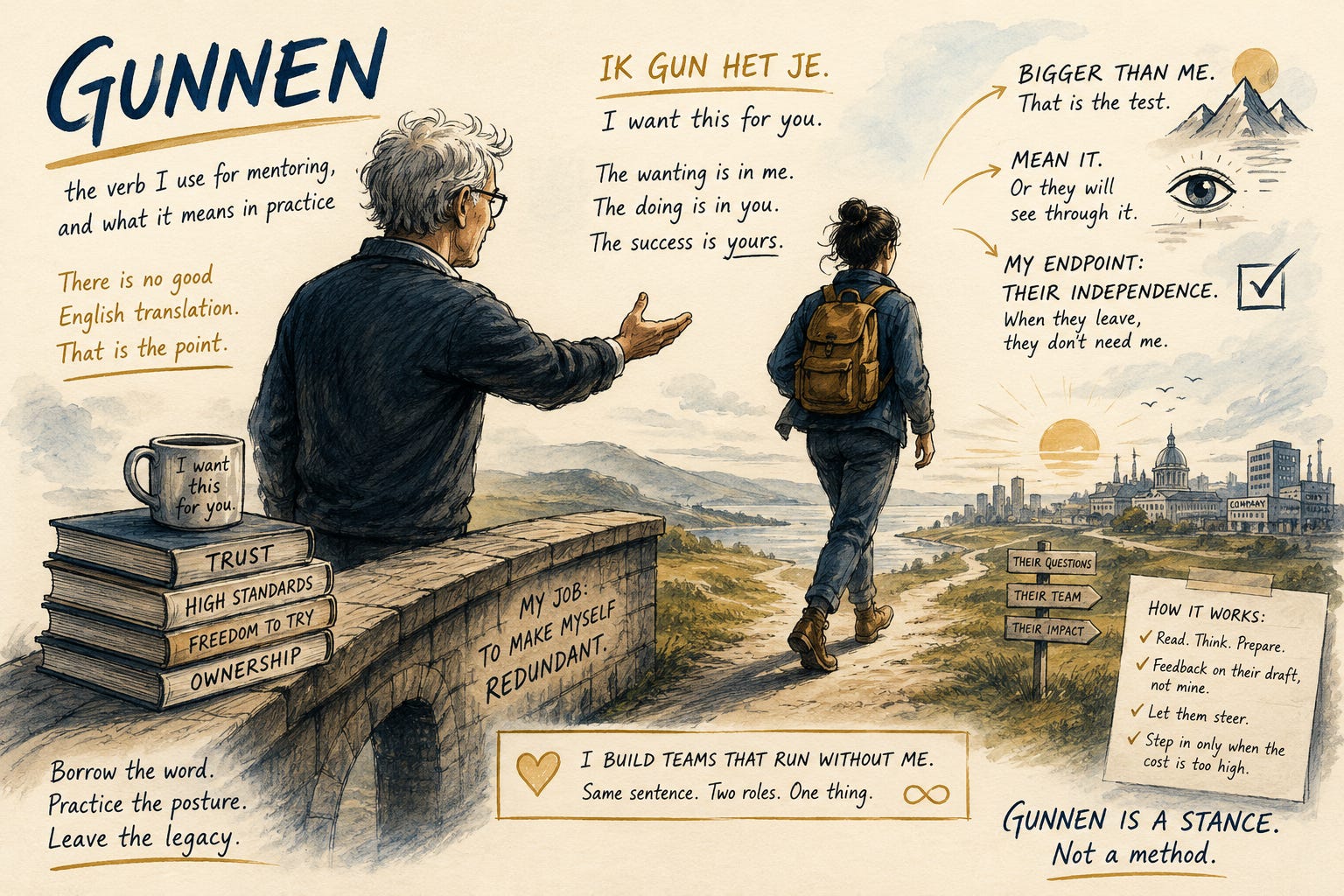
I have tried. “To grant” sounds bureaucratic. “To support” is too soft and too clinical at the same time. “To wish someone well” gets the feeling but loses the will. “To mentor” misses the real meaning entirely. Mentoring is a method. Gunnen is a stance.
The Dutch verb has a will inside it. To “gun” someone something is to want it for them – actively, with no calculation about what it costs you. It is most often used about good things: a promotion, a piece of luck, a hard-won result. “Ik gun het je” means I want this for you. There is no English sentence that does the same work in the same number of syllables.
This gap matters because the concept is the foundation of how I work with students, particularly PhD students. Without the right word, the practice gets misnamed constantly. People call it “developing talent” or “empowering students” or “supervising a thesis.” None of those address what the work actually is.
What it is
Three elements, short.
To gun someone something is to want them to become bigger than you. Not bigger than they were when they started. Bigger than the person standing across from them in the lab. That is the test.
It only works if you mean it. Students see through it inside a year, sometimes inside a week. If you are mentoring because it is expected of a senior, the student will know.
The endpoint is your own redundancy. A mentee who can design a study, write the paper, and defend their choices without you. When they leave the group, they should not need to send drafts back for comment. If they still need you, the work is not done.
What the outcome looks like
The only outcome I judge myself on in this role is whether my former PhD students now run their own groups and companies and mentor their own students the same way. Some have stayed in academia and supervise their own master’s and PhD students. Others have left for industry. Either way, the questions they work on are their own, and their co-authors are their own teams, not mine – unless I have done the work to deserve a place on the byline. The goal of gunnen is not for the mentee to become you. It is that they become bigger than you, in their own direction. Most of what they do now carries no link back to me, and that is the measure.
How it works in practice
The day-to-day is unglamorous. I try to read everything my students produce, or at minimum, I think hard about their work before we meet. Feedback is direct and limited: on their draft, not on the version I would have written. It is their PhD, not mine.
That second clause is the one that takes discipline. The easier path is to rewrite a student’s draft into your own voice and call that editing. It feels productive. It produces a clean text quickly. It teaches the student almost nothing.
The harder path is to leave the draft as the student wrote it, mark it only where it is genuinely wrong, and hand it back. Perhaps the paper will get rejected. The student will make mistakes again. They will catch some of them the second time. The mistakes they catch themselves teach them more than the instructions they follow without thinking.
I step in directly only when the cost of the mistake is too high: patient safety, irreplaceable samples, a deadline that cannot be moved. Outside those constraints, I let the student steer – including when they steer somewhere I would not have gone.
Why the verb matters
You can practice mentoring without the verb. People do. But the word changes the posture.
“To mentor” implies a relationship in which the senior has the knowledge and the junior receives it. The flow runs in one direction.
“To gun“ does not place anyone above anyone. It says: I want this for you. The wanting is in me. The doing is in you. The success is yours, not partly mine.
That distinction shows up in small choices. Whose name goes first on the paper. Whose conference talk it becomes. Whose grant proposal it builds into. If the mentor’s instinct is I helped, so I get credit, the relationship was wrongly framed from the start. If the instinct is I wanted this for them, and now they have it, the credit question does never arise.
This way of working is often mistaken for laziness. Some colleagues call me lazy and not much of a promoter. Some students leave when they find they cannot work without a steadying hand. So be it, I’m convinced of my way of working. The students and collaborators who stay, thank me later, and they have really deserved their credits because they really did it, not me.
The cross-role pattern
I should be transparent about something I noticed only later. I run a startup, ElmediX, in addition to my academic role. When I drafted what I wanted to be as the CEO of that company, the sentence I wrote was: I build a team that runs without me.
When I drafted what I want to be as a senior academic, the sentence I wrote was: until they are bigger than I am and I am no longer needed.
Same sentence, two roles. It is one thing, said twice, because it really is one thing.
I do not think this is special to me. Most senior people who are useful to those working under them maintain the same posture across whatever roles they hold. They may not have a Dutch verb for it. The posture is what makes the work worth doing for the next twenty years.
A small invitation
If you are a senior academic reading this and you find yourself rewriting drafts into your own voice, try the harder thing. Mark it up very limited. Hand it back. Let the reviewer reject it.... Tolerate the slower clock.
If you do not have a word in your own language for what gunnen names, borrow ours. We do not mind.
Disclosure: I am CEO and shareholder of ElmediX, a Belgian MedTech company developing whole-body hyperthermia for metastatic pancreatic cancer. This is my opinion regardless.